Skip to content
Gym Injuries? Here’s How Physio Gets You Back Training Stronger Than Before

Gym Injuries? Here’s How Physio Gets You Back Training Stronger Than Before

Back Pain Joint Pain Mobility Shoulder Pain Sports Injury


You’re midway through a set of Romanian deadlifts when you feel it: a sharp pull low and to the left of your spine, followed by a dull, spreading ache. You finish the set anyway. This is a mistake almost every experienced gym-goer has made at least once, and it usually adds three weeks to recovery.

Physio for gym injuries works best when it starts early. The biology of soft tissue repair is time-sensitive. Scar tissue that forms without appropriate loading tends to be less organised and less functional than tissue that heals under guided movement. 


The gap between muscle soreness and injury is real, and most gym-goers are guessing

Delayed onset muscle soreness is a training adaptation signal. It’s diffused, bilateral when the exercise was bilateral, and it improves with movement. Someone new to squatting will feel their quads for four or five days after a hard session. That’s normal.

What isn’t normal is localised pain at a specific joint angle. A rotator cuff under stress, for example, often presents as a sharp pinch between roughly 80 and 120 degrees of shoulder abduction. Every single rep. That consistency is the tell. It’s a structure catching, or compressing, or failing to control load at a specific point in the range. These two things feel different enough that most people know something is wrong, but they just choose to rationalise it.

The other category worth naming is overuse injury, which gets conflated with acute injury constantly. Knee pain that builds gradually after adding heavy leg press to your running practice feels completely different from the sharp, sudden pain you’d get from twisting your knee or spraining a ligament. There’s often no incident. The pain builds across a training block, is worse the morning after hard sessions, and temporarily reduces mid-warm-up before returning. Treating it with rest and anti-inflammatories, as many people do initially, addresses the symptom and misses the problem entirely.


“I’ll rest it” is not a treatment plan

Passive rest for most gym injuries produces worse long-term outcomes than early active management.

The mechanism matters here. Tendons under prolonged unloading lose stiffness. When you return to training, the tendon transmits force less efficiently, load distribution across the tissue changes, and the injury recurs, often at lower training volumes than before. We have seen this pattern with Achilles tendinopathy in CrossFit athletes, patellar tendinopathy in dedicated leg-day trainees, and proximal hamstring injuries in people who treat their posterior chain as an afterthought. Six weeks of rest followed by a tentative return to the same program is a very reliable way to spend another six weeks injured.

The right approach is progressive loading of the affected tissue, calibrated to what it can tolerate, and increased systematically over time. It is entirely specific to the individual which is why a generic exercise program from the internet reliably fails.
What a physio is actually doing when they assess a gym injury


Take a 29-year-old who presents with anterior knee pain after increasing their squat frequency from twice to four times per week over six weeks. The first clinical question isn’t “where does it hurt.” It’s whether the pain is tendon-mediated or joint-mediated, because those require different interventions that can actually make the wrong diagnosis worse. Tendinopathy is loaded progressively. Kneecap pain, on the other hand, usually means pulling back on training first and looking at how you’re moving before building load back up.

A thorough assessment looks beyond the knee itself. Weak hip muscles can cause the thigh to rotate inward during a squat, which puts extra pressure on the kneecap. Tight ankles do something similar. When they can’t bend far enough, the knee compensates by collapsing inward to make up the difference. Both of these show up as knee pain, but neither of them starts at the knee. 

It will also consider training context – how much volume, what sleep has looked like, whether there have been other stressors. Knee pain from the gym is not just a knee problem. 

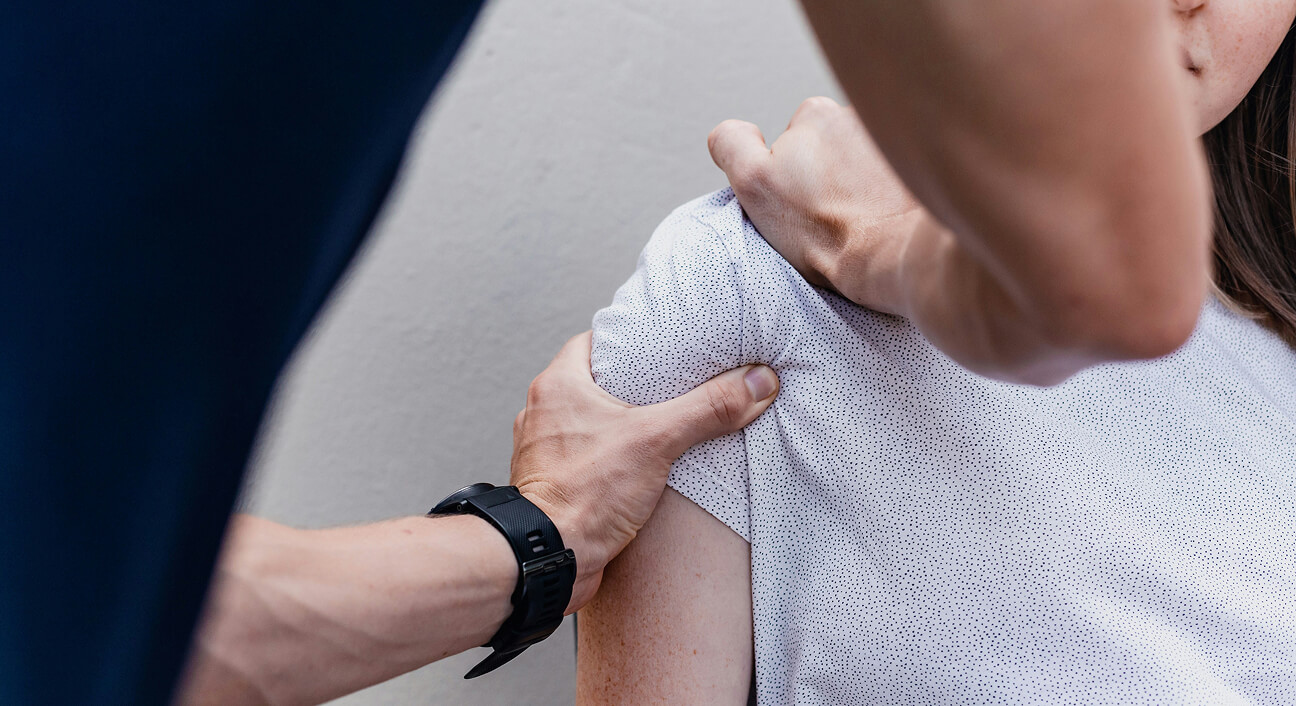
Hands-on treatment, including soft tissue work and joint mobilisation, serves a specific purpose in this process. It reduces the protective guarding response that prevents someone from completing a meaningful assessment in the first place. The outcome is won in the rehabilitation program and whether the patient executes it.


Staying active during recovery is almost always possible, and almost always better

Complete rest from all exercise is the right answer for a narrow set of gym injuries such as broken bones, suspected fractures, or significant swelling inside a joint. For the vast majority of presentations, the goal is to identify what can continue safely and design around what can’t.

Someone with a shoulder impingement pattern does not need to stop training the lower body, core, or the unaffected side. Someone with a lower back strain can, in most cases, continue upper body work and low-load lower body movements within days. The physio’s job is to be specific about what the boundaries are.


Return to training is a set of measurable criteria

The most common reason gym-goers re-injure themselves is returning to their previous load as soon as they feel good enough.

For a hamstring strain, for instance, return to heavy Romanian deadlifts requires demonstrable symmetry in eccentric hamstring strength, pain-free performance of a series of loaded functional tests, and a period of progressive loading that respects the timeline of tissue remodelling, which at the tendon-bone junction is measured in months. 

For a rotator cuff injury, returning to overhead pressing isn’t just about the shoulder feeling okay. The muscles that control your shoulder blade need to be strong enough to keep the joint properly aligned when you’re pushing weight overhead. Your physio will test this before clearing you to load it.

Timelines for gym injury recovery exist on a meaningful spectrum. Mild overuse injuries with early intervention can resolve in two to four weeks. Tendinopathies, properly managed, often require two to four months. This is biology. Trying to compress the timeline by training through pain costs more time than it saves.

Prevention is mostly about honest accounting of your training load


Most gym injuries are predictable in retrospect. A sudden increase in training frequency without a corresponding increase in recovery. A rapid jump in absolute load. Accumulating sessions on poor sleep. The 10 percent weekly load increase rule you’ve probably heard is an oversimplification, but tissue adaptation lags behind cardiovascular fitness and motivation. The body’s capacity to generate force outpaces its structural readiness to absorb it, and something gives.

A movement screen with a physiotherapist, done before an injury forces the conversation, identifies the asymmetries and mobility restrictions that are quietly building risk. It costs one appointment.


If something has been bothering you for more than a week, it’s time to get it looked at

At Instinct South, we have been treating South Melbourne’s gym community for over 35 years. We know what a serious training injury looks like and what a manageable one looks like, and we know the difference between a program that needs adjusting and a tissue that needs protecting. Most gym injuries that come to us late do so because the person convinced themselves it would settle. Sometimes it does. More often, by the time they arrive, there’s more to unpack.

Book an assessment this week. We will tell you exactly what’s going on, what you can keep doing, and how to get back to full training as fast as the tissue will allow.

Book an Appointment | Contact Our Team